At Farasis Energy USA, our research and engineering team spends a lot of time on the problems standing between promising battery materials and real-world commercial products. Silicon anodes are one of the biggest opportunities in the industry and one of the hardest to get right.
We recently published a study in Journal of Power Sources that goes deep on a problem the industry has struggled with for decades.
Why Silicon Anodes Are So Difficult to Commercialize
Silicon can store nearly ten times more energy than graphite, but the obstacle has always been mechanical. Every time a silicon anode charges, it expands by up to 380 percent. That expansion builds intense internal stress, causing particles to crack and degrade rapidly. This is a main reason silicon anodes have been difficult to commercialize despite decades of research.
Researchers have long understood the problem, but predicting that stress quantitatively and validating those predictions against real measurements has remained out of reach. Our team built a model that does exactly that.
The Stress Model That Changes the Calculation
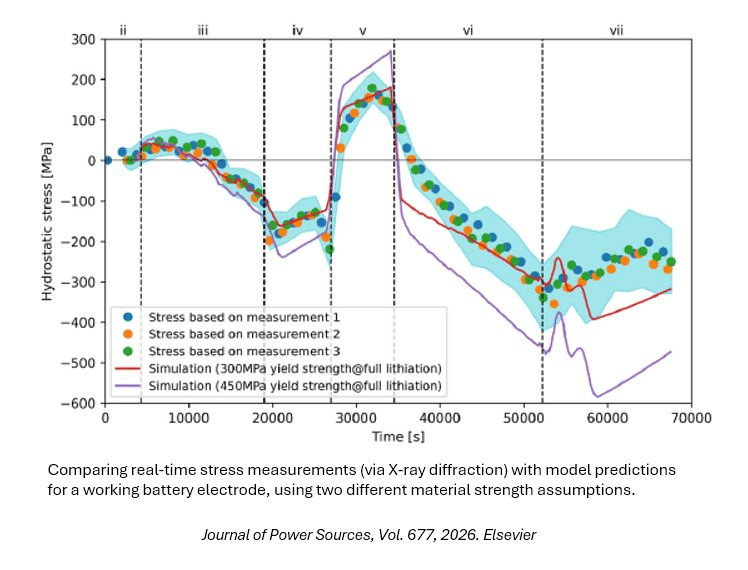
The study uses a diffusion-mechanical simulation model validated against published synchrotron X-ray diffraction data from an independent research group. It captures how stress builds and changes inside silicon particles across a full two-cycle charge and discharge profile, the first time silicon anode stress evolution has been predicted quantitatively and validated against real measurements.
As Dr. Jifa Mei, the study’s lead author, put it:
“What this work shows is that hoop stress on the surface of a silicon particle repeatedly swings between compressive and tensile yield during cycling. That fluctuation, combined with accumulated plastic strain, is what drives surface damage.”
Where We Go From Here
Building on years of internal simulation work, we can now pursue silicon-carbon anode designs with greater precision and confidence. Our target is cells that sustain beyond 2,000 cycles in real-world conditions.
If you want to dig into the details, the full study is available in Journal of Power Sources.